Sunday, June 9, 2013

Google Network Vs Yahoo-Bing Network

Everybody knowing or having interest in search marketing would know that Google dominates search volumes. In the US of A, Google handles two-thirds of all search queries. However, can we ignore the network that accounts for one-thirds of the search queries that consumers type-in in the US?

The truth is that we know very little about the Yahoo-Bing Network (YBN).

This post is about a research done by AdGooRoo which sought to gauge the success of the YBN network in gaining market share against Google. The research report from AdGooRoo compared the performance of Yahoo! Bing against Google in six critical verticals.

Verticals basically referred to those industry segments that account for the majority of the total search traffic and click-throughs in the U.S. Search market. Comparing the paid search spends of these industry segments could give a representative idea of where each of the networks stand in terms of search effectiveness and outcomes.

The industry segments measured were as follows:
  1. Retail (Shopping & Classifieds)
  2. Financial Services
  3. Travel
  4. Education
  5. Computer & Internet
  6. Business to Business
This methodology of dividing the spends into verticals was interesting. It brought up a number of questions, such as
  1. Which are the verticals where Google is dominant, and to what degree?
  2. Is Google dominant in every aspect of paid search - Impressions, Click through efficiency, CPC, CPL etc
  3. Can we compromise on impressions to get lower CPLs in some of the industry verticals? etc.
While the report had the obvious findings, it also had a few surprises. Please read on to get a quick gist of the report.

Impressions:

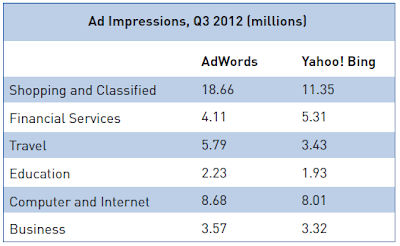
Google Adwords served more impressions in all the verticals except for 'Financial Services'. Retail as a vertical, is the biggest money-maker for advertisers and Bing was a distant second. The research was done in Q3, 2012 and Google had 7.3 million impressions more than YBN in one quarter alone, for 'Retail'.

Bing Ads performed strongly against AdWords in several other verticals in terms of ad impressions. It outperformed AdWords in the Financial Services vertical with 5.31 million impressions compared to 4.11 million for AdWords. Analysts have credited the popularity of Financial Services on Yahoo! and MSN for pushing Bing Ads into the lead.

Click-Through Rates (CTRs)

In addition to earning more search traffic, advertisers on AdWords experienced higher CTRs on Google network, with AdWords campaigns getting 2.4 to 5.9 times higher CTRs than those on YBN during the same period.

Interestingly, for advertisers who were active on both the engines, quite a few of them got higher CTRs on YBN including Citicards and Fidelity Life. Quite obviously, it was found that among the 39,000 advertisers surveyed, 55% of them were running ad campaigns on both AdWords and YBN.

Otherwise, the competition in terms of CTRs was completely one-sided favoring Google. The biggest discrepancies came in Financial Services (3.53% compared to .81%), Travel (4.14% to 1.27%), and Business to Business (3.12% to .60%).


Cost-per-Click (CPC)

Not surprisingly, CPCs for YBN were invariably lower. There is a price to be paid for Google’s successful track record with AdWords. While CPC data was fairly close in each vertical, the Computer and Internet vertical saw a CPC rate on AdWords that was 117% greater than Bing Ads.

As a result of lower CPCs, impressions were cheaper on the YBN. It varied from 76 to 90 percent cheaper on average. YBN therefore can be taken as a brand awareness medium giving high visibility at a lower cost.

For a lead generation campaign, YBN may not give high volumes, but can bring in leads at a lower cost per lead. It can prove to be very useful for brands who cannot handle high volumes of leads coming into the system.


Conclusions:

As an advertiser, I would suggest presence in both the networks. It would only put a multiplier effect on the search outcomes in terms of lowering of cost and increase in volume of leads.


Tuesday, March 19, 2013

General Mills Yogurt Brand Yoplait on Twitter.

Twitter is a media that consumer brands of today cannot ignore, or be careless about. With Twitter and Facebook  the brand has to be active, living and breathing 24/7.

The brand has to post, read and respond every minute of the day. It has to do all three keeping the brand positioning and attitude in mind.

I have come across an article which gives a good example of how Twitter and Pinterest among other social media is being used by a Yogurt brand called Yoplait from the house of General Mills.

You can either click here or read the article copied here in my blog. Courtesy: http://sproutsocial.com


Why General Mills Yogurt Brand Yoplait Sets an Example on Twitter

When you start with a popular consumer food item, especially one like flavored yogurt, it’s that much easier to create a great brand presence on Twitter. We spoke with Alexandra Heide, Community Engagement Specialist for General Mills’ Yoplait brand, to get her take on the value of incorporating what she calls “joy” into Yoplait’s Twitter account.

The tone of Yoplait’s Twitter account is always upbeat. Whether it’s tweeting about who to watch on the red carpet at the Oscars, or links to innovative yogurt recipes, the brand posts a nice mix of product and non-product related tweets. The common theme is always fun and positivity. “Just like the way people enjoy our product, we like to provide Twitter content in bite-sized portions,” says Alexandra.

The brand also appears to have subtly associated itself with health and social issues by posting links to promote events like Athleta Esprit de She and International Women’s Day. This is not only a way to reiterate the positive theme of the Twitter account, it’s also a clever way to post content that’s relevant to the brand’s target audience.

Let’s take a closer look at how Yoplait uses the overarching concept of fun, along with specific strategies like posting images, soliciting feedback, and using social media management tools and teams to carve out a commanding presence on Twitter.

A tangible way that Yoplait contributes to the success of its Twitter account is to post lots of fun and colorful visual content. Following a strategy we’ve long espoused, it posts pictures from its Instagram account, including generic upbeat images like the one above. Of course, it posts lots of product shots as well. These are usually accompanied with some thought-provoking copy, such as “What challenges are you facing today?” As you might expect, Yoplait also has vibrant image galleries on Facebook and Pinterest and occasionally cross-posts these pictures to Twitter. The net result of all these images in its Twitter stream is that Yoplait’s followers are exposed to numerous visual impressions of the brand in a way that never seems like advertising. The visual strategy on Twitter is obviously working. Alexandra confirms that its visual content always gets the most interaction whether it’s “a picture of yogurt pops or a cute baby animal.” 

Other tweets that you’ll see a lot of when you peruse Yoplait’s stream are solicitations for feeback, suggestions and input from its followers. “We get a lot of product suggestions for new flavors and new products,” says Alexandra, adding that they’re always interested to hear what their fans think of the brand. 

It’s evident that fans are obviously paying attention to the brand on Twitter because the account is filled with retweets from happy consumers. Perhaps because of the health-conscious connotation of Yoplait yogurt, a lot of celebrities like Chris Tucker and Carmen Electra have been willing to lend their endorsements to the brand as well.

Saturday, January 12, 2013

Business Modelling - India as a Market !

India is supposedly a hot market for the world, and the entrepreneur enthusiast. A rising urban consumer population with increasing disposable income is becoming a target market of choice for many aspiring businesses. Absolute number of consumers in India and especially in the Metro cities, gives a positive shade to any initial discussions about new revenue models.

Innovation in Internet technology and India being a country with a huge pool of IT experienced working class is giving rise to a lot of business ideas at various stages of incubation. E-commerce, Payment Gateway and Mobility related business ideas are discussed at almost every coffee discussions between professionals.

For consultancy, contact info@kuhipaat.com
Quite obviously, almost all of these businesses are targeted at the retail consumers. Starting from global business ideas, which have become successful such as 'The Facebook' and 'Twitter', to smaller business ideas that are sprouting in every Indian city, every business is targeting the retail consumers.

Target Market definition and its true potential builds on a business model. Going by the normal belief that 1 out of every 100 business ideas fail, it is critical that this target market called India is studied and understood a bit more incisively to get business and revenue objectives accurately and realistically.

India is fragmented.

It sounds like a no-brainer, and we tend to get blind by accepting it as a common place argument. We need to go beyond the fact that India is fragmented. It is not about demography. Businesses need to deal with the softer aspects of psychology to ascertain the consumer demand for a particular product proposition.

The need is to delve into the fragments and its associated consumer behavior, attitude and mindsets. India is divided into a rural and urban mindset. Within urban mindset, we have original urbanites, second generation migrants and first generation migrants. Then there is the mindset of highly skilled labour, semi skilled labour, self-employed and marginally employed labour.

Access to media is fragmented. Access to free office Internet, Smart phones, Facebook, Twitter, Television, Radio and newspapers is not homogeneous, and hence information consumed is not uniform. As media is a critical element in forming lifestyle related attitudes, it creates fragments that are not easily comprehensive. Similar is the extent of globalization of the mindsets. Similar is the adherence to religious and cultural beliefs.

India is rigid.

It is bind to its traditions and customs for thousands of years. The best examples of it, are to analyse the long rule of the Mughals and the continual charity / religious work by Christian missionaries. India has stayed a Hindu majority country. Christian missionaries have invested and created schools and hospitals all across the country. 'Don Bosco' and 'St. Mary's' sound like initiatives of the Indian Government. It is unfortunate that Indian Government didn't have the vision to create such brand names for education in the country. Irrespective of these facts, India has stayed bind to its traditions, customs and religions. Parents send their kids to Don Bosco to pursue English education with a chandan, or saffron, or kesar, or kumkum tilak on their heads.

The simple conclusion to draw from this discussion is the fact that changing behavior in India is not so easy. India is an elephant that takes time to analyse and arrive at decisions regarding change. Kellogg's is a classic case of surprise that the top management of Kellogg's got when they entered India in the early nineties. Introducing cereals as breakfast to the Indian consumers met with unexpectedly strong resistance. In the US, corn flakes are had with cold milk, whereas in India, it was hot milk when consumers slowly started accepting corn flakes as their breakfast cereal.

Famous brands such as Mercedes, Coca Cola, Citibank experienced similar surprises because they had been blinded by figures. They all forgot to understand India qualitatively.

India is price sensitive.

Every Sunday, Big Bazaar has a 5% discount. India is one of the country where credit cards are available without any annual fee. A Rs. 2 increase in Petrol prices creates traffic around petrol pumps to save Rs. 50 to Rs. 100. India saves by being price sensitive. There is greater trust on holding Gold for future, as compared to any other savings and investment schemes.

This psycho-cultural trait is pertinent to any revenue model to arrive at a realistic earning potential of a business. Fee income business in India is therefore a doubt. Consumers in India seems to have a belief that they are doing a favour by deciding to buy the product or the service. Fee income, if packaged upfront could face huge consumer resistance. The value of convenience is not realized against the opportunity cost of the service being inconvenient. The consumer benefit of providing convenience therefore has to be looked from the point of gaining consumer acceptance, not as a revenue opportunity from the end consumer. The revenue opportunity exists among intermediaries, and in the supply chain coming together to provide the convenience.

India is a potent B2B market as well.

This fragmented retail consumer base gives rise to immense risk in terms of conceptualizing a business and can therefore lead us to this B2B marketplace. The B2B marketplace in India is comparatively homogeneous and offers equally potent business opportunities. Importantly, it is not a targeted marketplace by one and all.

B2B business is about enabling another business or business processes. The target market for B2B business can be one large corporate. One corporate can make the business profitable and sustainable.

Online Payments as a business opportunity is attracting a lot of entrepreneurs and investors. India being one of the most progressive countries with advanced payment systems like NEFT, RTGS, IMPS, ACH and NFS, transfers of money between bank accounts have become enabled through varied means. With IMPS, mobile payments is a robust reality. With ACH, cash collection and management assumes a new paradigm.

The argument is that online payments business can either be targeted at providing convenience to the retail consumers, or be targeted at businesses to make their payment processes simpler, operation-efficient, cost-effective and audit friendly. And it may be just easier to target businesses. So it is imperative that unlike what is commonly observed, business modelling requires a strategic thought towards B2B potential, apart from focusing on the retail consumers.

Conclusion: 'Business Modelling' is a huge discussion. This blog post is an attempt to give cues to further analyse and arrive at a target market definition that has the maximum business potential. This is not exclusive, and is intended to farther thinking in the direction proposed by the blog.

Comments are welcome. We can add to this discussion for everybody's benefits. I would be glad to answer questions with regards to any confusion or fluidity.

The author has an experience of 12 years in the integrated branding, communication and financial domain involving traditional as well as digital media. He can be contacted at durlov@kuhipaat.in for consultancy and project execution.